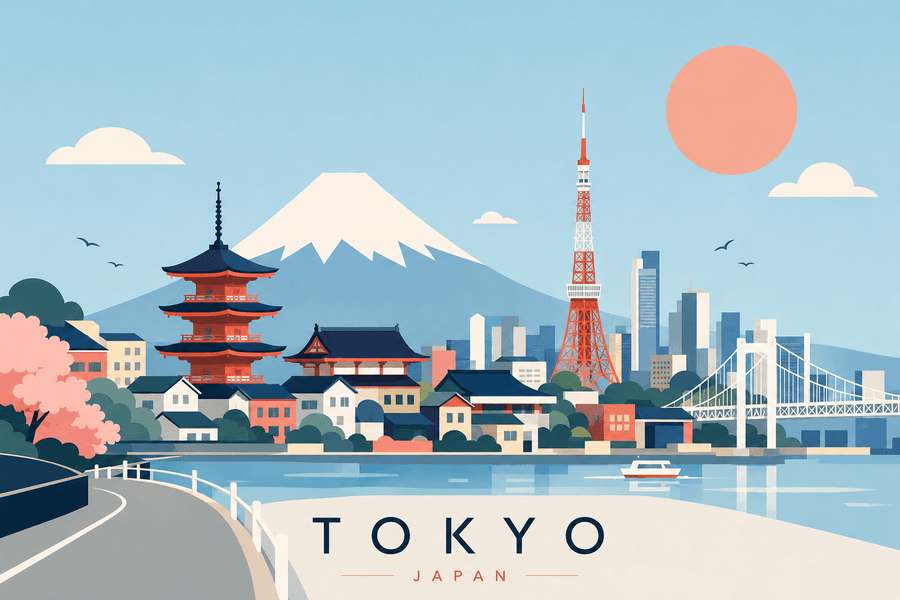
Some trips begin long before the flight.
Japan, for me, probably started somewhere in childhood.
Back in the Doordarshan days, there was Oshin. I don’t remember every detail now, but I remember the feeling it left behind. Quiet resilience. Simplicity. A life shaped through discipline and endurance. At that age, I didn’t understand Japan. But I think that was the first time the country entered my imagination.
Summer vacations back then were slower. No phones, no endless scrolling. Reading was how time moved. Travel writing became a window to places I had never seen.
One book series I still remember vividly is Apoorvarang by Meena Prabhu. Her writing had this ability to make places feel lived-in rather than described. One part of the series focused on Japan, and I remember reading it almost obsessively over two or three days. My mother was more concerned about why I wasn’t doing anything else the entire day.
But somewhere between those pages, Japan became more than a country on a map.
There were other influences too. Samurai stories. Japanese characters in video games during college. Years later, watching Shōgun brought that fascination back again.
So when we finally landed in Tokyo this year, it didn’t feel completely unfamiliar. It felt like arriving at a place that had quietly existed in the background for years.
We landed in Tokyo in the afternoon. That odd time where your body is tired, but your mind is too curious to rest. The airport was busy, but strangely calm. People moved quickly, yet nothing felt rushed. No unnecessary noise. No confusion spilling into the next person’s space.
And then came the first train ride into the city. Clean stations. Silent compartments. People standing in queues without being told to. Nobody speaking loudly on the phone. Nobody trying to get ahead of everyone else. Within a couple of hours, one thing became clear.
Japan wasn’t going to stay limited to its places.
Cleanliness that quietly follows you everywhere
The cleanliness is the first thing everyone notices, and honestly, it deserves the reputation. But what surprised me was not that famous places were clean. It was how consistent it felt. A random street corner. A station platform. A small restaurant lane. Convenience stores at midnight. It all carried the same sense of order.
Even construction sites looked disciplined. Back home, construction usually announces itself loudly - dust in the air, broken footpaths, temporary chaos becoming permanent. In Japan, work was happening everywhere too, but somehow without disturbing everything around it. There were exceptions, of course. Some Korean and Indian alleys felt slightly less polished. A little more relaxed. But even there, it never felt unmanageable.
And the interesting part was this: The cleanliness didn’t feel enforced.
You rarely saw anyone policing behaviour. Yet people simply followed what was expected of them.
A society built on small acts of consideration
The more time we spent there, the more we noticed how much Japanese public life runs on consideration for others.
The metro is probably the best example. Even during rush hour, compartments stayed quiet. People spoke softly if they spoke at all. Nobody played videos loudly. Nobody turned public space into personal space.
At first, the silence feels unusual. Then after a few days, you realise it actually makes shared spaces less exhausting. Queues exist everywhere. Train platforms, escalators, stores, elevators. And nobody needs to manage them.
Signals are another thing. People wait patiently even when the road is empty. For someone raised in India, where crossing a road is sometimes based on instinct and negotiation, this was fascinating to watch.
We joke about “Indian Standard Time,” but in Japan, time feels collective. If everyone respects it, everyone benefits from it.
And then there are the small moments that reveal more than landmarks ever can. Once, while transferring luggage, we were struggling a bit with the address form. The lady at the counter simply took the paper from us and filled it herself so we wouldn’t make mistakes. No irritation. No performative hospitality. Just quiet helpfulness. Another time, our bus driver said “thank you” when the signal turned green. Not dramatically. Not as customer service theatre. Just naturally.
Small things. But after a while, these small things become your memory of the country.
Trust feels normal there
One thing I kept noticing in Japan was how much society seems to operate on trust.
You genuinely feel like you could forget your passport in a restaurant, come back after a few hours, and still find it untouched. That level of trust changes how a place feels. At the same time, I learned that umbrellas apparently live under different social rules.
Passports are safe. Umbrellas are not guaranteed. Japan remains balanced.
Tokyo moves fast. Kyoto breathes slowly.
Tokyo feels like a machine built with precision. Everything moves. Trains arrive. Crowds flow. Crossings fill and empty within seconds. Yet even at its busiest, Tokyo never felt chaotic.
Kyoto felt completely different. Quieter streets. Slower evenings. More pauses between things. You notice details more in Kyoto - the sound of footsteps in smaller lanes, the calm around temples, the way the city settles after sunset.
But despite their different rhythms, both cities felt connected by the same underlying values. Respect for shared spaces. Awareness of others. Quiet discipline.
Mount Fuji, and the Japanese relationship with nature
There’s also something deeply calming about how nature exists alongside daily life in Japan. Even near cities, landscapes feel protected rather than consumed.
And then there’s Mount Fuji.
You don’t even need to be close to it. The moment it appears in the distance, everything around it changes slightly.
Maybe because we grow up seeing it in photographs, films, paintings. Maybe because it carries centuries of cultural weight. Or maybe it’s simply because some mountains feel larger than geography.
Fuji doesn’t demand attention aggressively. It grows on you slowly. Like many things in Japan.
What stayed with me
There’s a Marathi line that kept coming back to me during the trip:
“प्रवास माणसाला फक्त नवीन ठिकाणं दाखवत नाही, तो त्याला स्वतःकडे नव्याने बघायला शिकवतो.”
Travel doesn’t just show new places. It changes the way you look at yourself.
Japan did that quietly. Not through tourist attractions or famous landmarks, but through everyday behaviour. Through systems that work because people choose to make them work.
It made me think about habits I usually don’t notice. Being on time. Being quieter in public spaces. Being more mindful of people around me. I don’t think anyone comes back from Japan completely unchanged. Even if it’s something small. And honestly, maybe that’s enough.
Because Japan, at least for me, was always going to be beyond the places.